Root Cuttings - Diospyros and Crateagus
When it comes to propagation, some plant varieties are far more cooperative than others.
For example, Acer palmatum ‘Koto Hime’ is about as easy as it gets. Because of this, it has been very popular in North American bonsai nurseries since the 1980s even though it is a rather inelegant substitute for ‘Shishigashira’, which requires significantly more effort, time, and knowledge to propagate.

Whereas simple softwood cuttings taken in mid to late spring work well for many Acer palmatum cultivars, sometimes softwood cuttings just don't work at all.
Take the beloved Crataegus cuneata ‘Matsudaira’ cultivar; this hawthorn strain is nearly impossible to propagate from softwood cuttings. The classic nursery-industry approach would be to take cuttings of standard Crataegus and graft the ‘Matsudaira’ cultivar onto them, but that doesn't usually create very interesting bonsai material.

Mr. Koichiro Toyoya of Fukuju-en has developed a sophisticated method for producing Crataegus cuneata ‘Matsudaira’, though it requires an extremely high level of skill and a nearly unreasonable amount of time. I travelled to Japan in 2024 to learn this process from him.

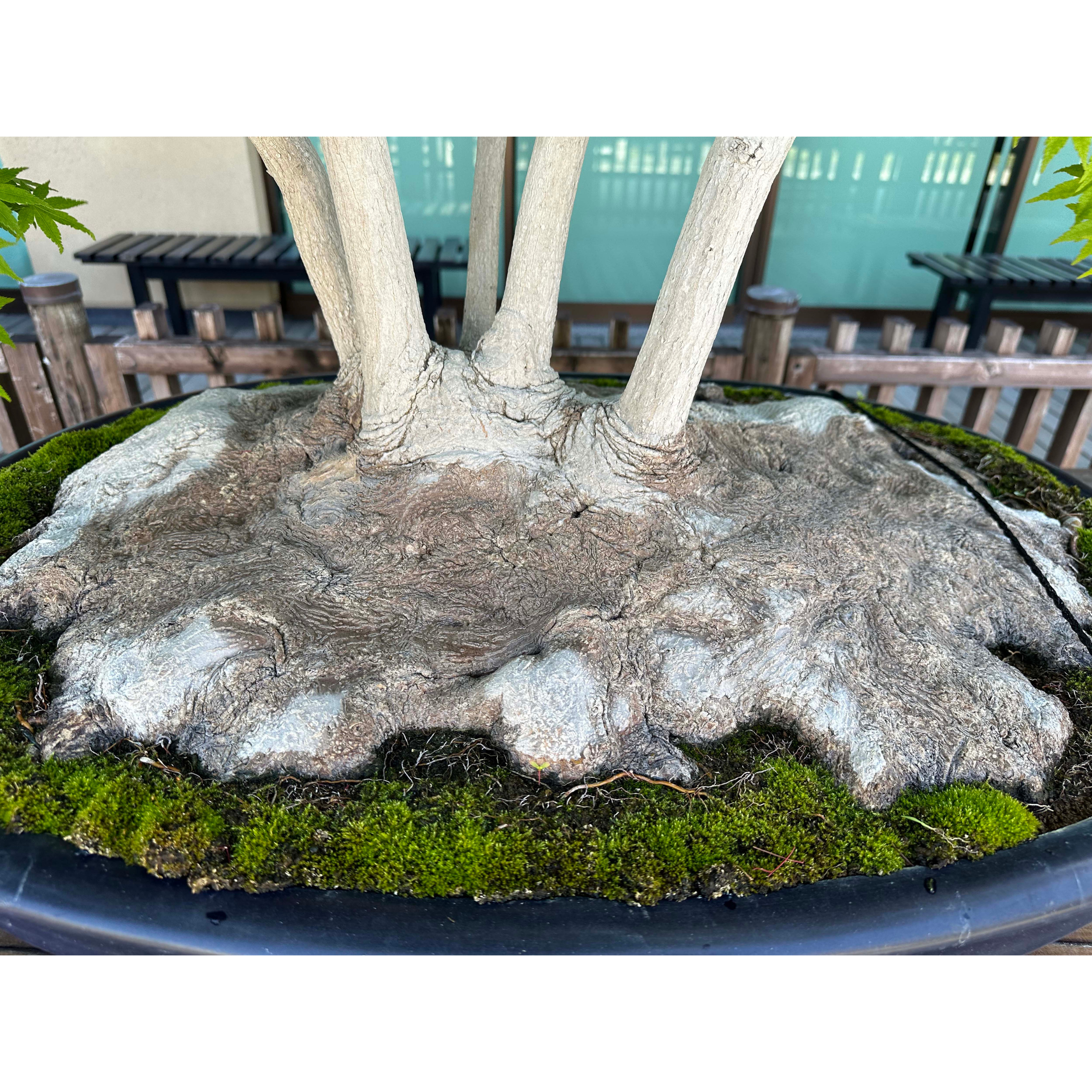
In the image above, the majority of what you're looking at is a root cutting of standard Crataegus, onto which numerous ‘Matsudaira’ scions have been grafted.
Below is clear close-up of a graft, on a visually simpler design. On a single tree there might be up to 15 bud grafts like this! Each individual bud graft is a technical achievement itself, and its success demonstrates the significance of the 4 decades of grafting experience that goes into every slice and gesture.

What is a bud graft? Here is a picture stolen from THIS website.
Now imagine doing 15 of those onto the same piece of root... It's hard to believe until you see it happen infront of you.
THE ROOT OF THE MATTER
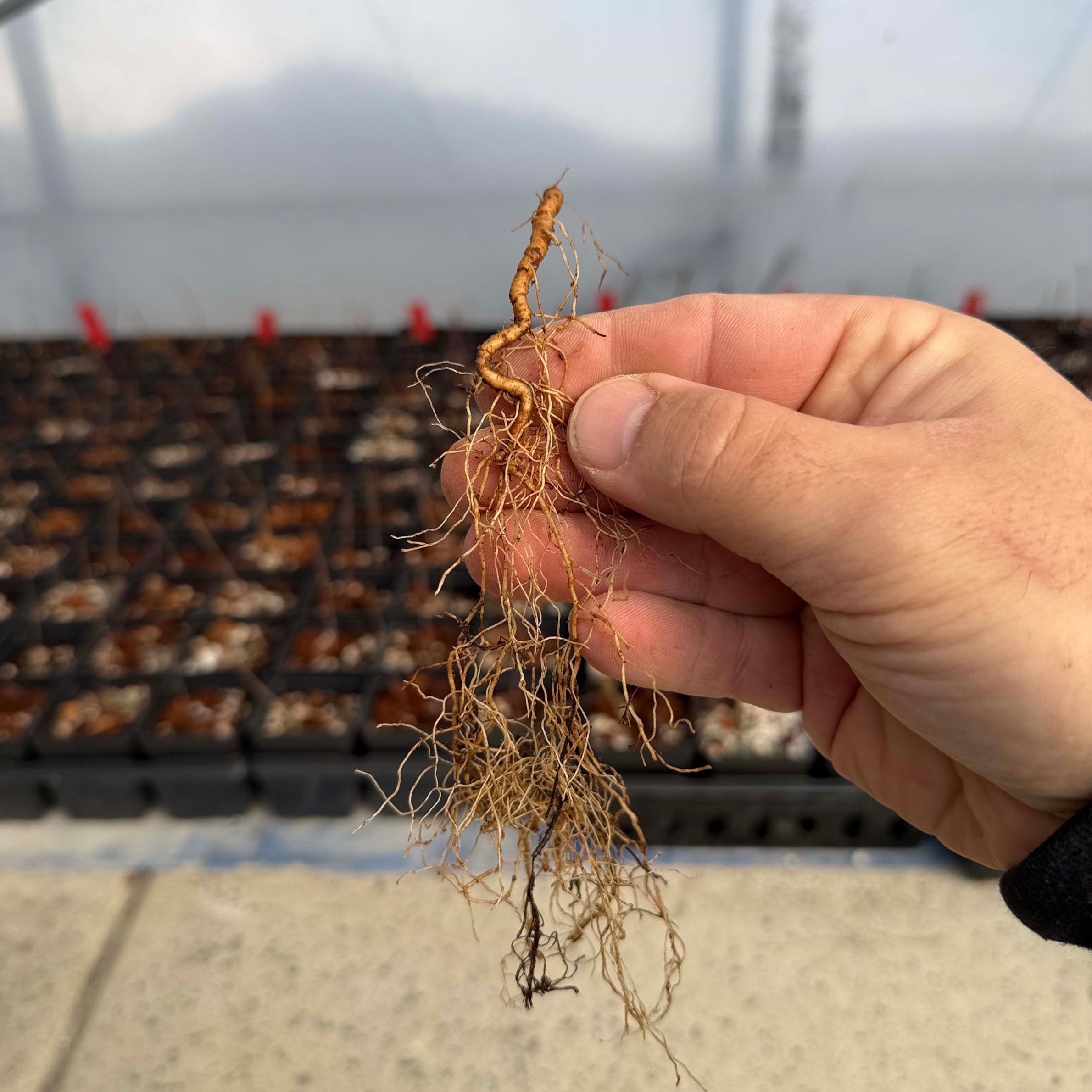
Anyone who has worked with root cuttings knows that they usually look like this:

After a year of growth, they develop into root cuttings like these Diospyros rhombifolia – Princess Persimmon, which will be available on March 14, 2026 at 10h00 ET.


So how do we create root cuttings that look like this, with 5-8" of beautifully tangled height?

On the Bonsainut forum, bonsai ceramicist Nao Tokutake made a fascinating suggestion. Check out post #255 HERE. If you are not a member of the forum yet, you are truly missing out!

Inspired by Nao’s idea, I decided to use a deeper sub-pot to allow my future Crataegus root cuttings to develop more height. The idea is to let the roots extend into the lower pot, grow for 3-4 years, and then chop them off hoping that they survive on their own
I did the exact same thing for Diospyros rhombifolia, onto which I will carefully graft desirable cultivars.
I have a few other species in mind that I think this could work well with...
Enough words from me—the following pictures should be self explanatory.


I'll post a follow-up in 2028? 2029?
Please note that the lip on my lower pot will prevent me from easily inserting a knife and slicing the roots in order to separate the top pot from the lower pot. A better alternative would have been to use an 'Anderson flat' as the lower pot, filled to the brim. My 'Anderson flat' style trays are only 4" tall, and I wanted to have at least 8-9" for this experiment. (I did also do a perform a bunch in 'Anderson flat' style trays).